MedGSSR: Generalizable Medical Image Super-Resolution 3D Reconstruction via Hierarchical Feed-forward Gaussian Splatting

Chengkai Wang1*, Luoyu Hong2*, Yiting Zhao2, Jiamin Wang3, Xiang Feng3, Feiwei Qin2, Zhenzhong Kuang2, Xuefei Yin4, Ali Bashashati1†, Yanming Zhu4†
1University of British Columbia   2Hangzhou Dianzi University   3ShanghaiTech University   4Griffith University
* Equal contribution † Corresponding author

ECCV 2026

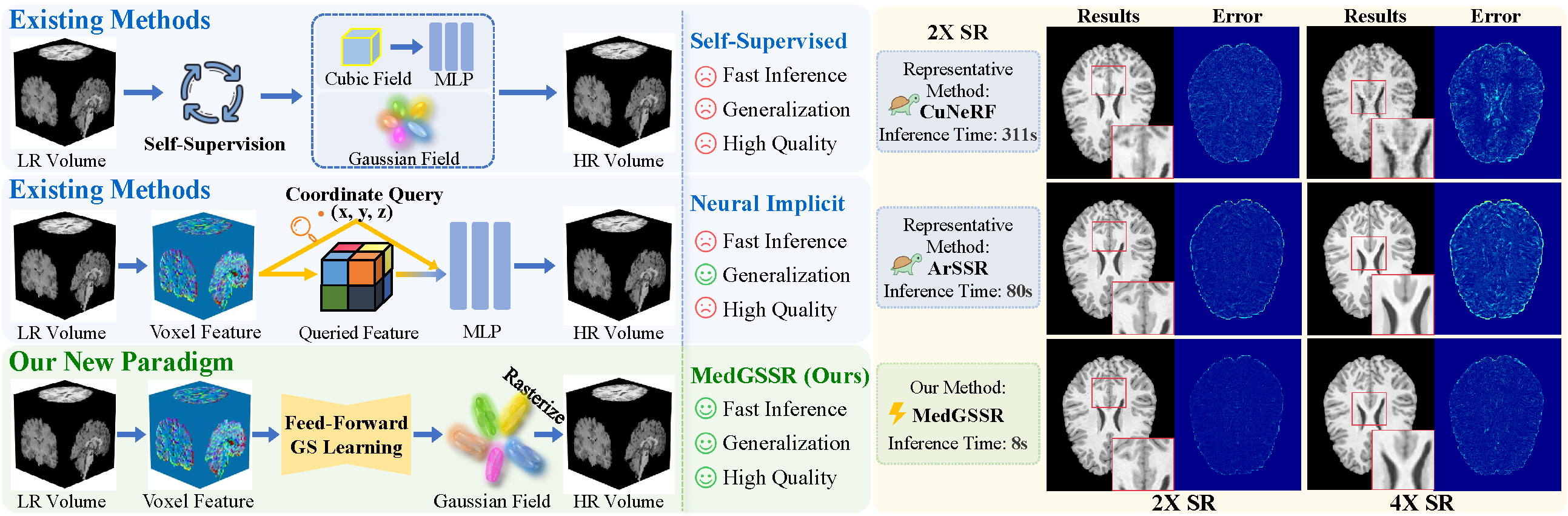
MedGSSR teaser showing the feed-forward Gaussian field paradigm and 2x/4x super-resolution results

MedGSSR introduces a paradigm shift for Medical 3D Super-Resolution. Left: Existing self-supervised methods (relying on isolated optimization) and neural implicit networks (relying on coordinate querying) fail to simultaneously achieve fast inference, robust generalization, and high-quality reconstruction. MedGSSR introduces a generalized feed-forward 3DGS paradigm that explicitly satisfies all three clinical requirements. Right: Cross-dataset visual comparisons (trained on MSD, tested on HCP) at 2× and 4× upsampling scales. Compared to baselines that produce geometric artifacts or over-smoothed textures, MedGSSR accurately restores high-frequency anatomical structures with the lowest error (dark blue in difference maps) while accelerating inference by an order of magnitude.

Abstract

High-resolution volumetric medical imaging is critical for clinical diagnosis, yet acquisition is often limited by scanner hardware, scan time, and for CT, radiation dose. Medical 3D Super-Resolution (Med3DSR) offers a computational alternative, but existing methods commonly rely on per-subject optimization, pretrained priors, or coordinate-based implicit representations, which compromise anatomical fidelity and limit efficiency.

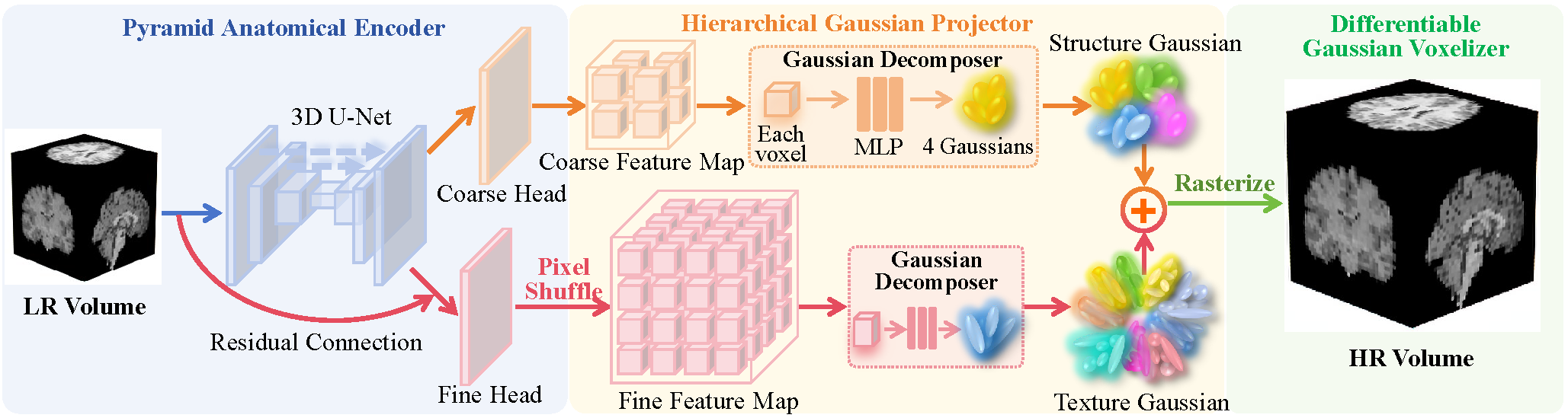
We present MedGSSR, a fully end-to-end feed-forward framework that represents volumes as an explicit 3D Gaussian field for Med3DSR. Unlike coordinate-based implicit functions, our explicit 3D Gaussian representation naturally enhances signal continuity and local high-frequency fidelity. MedGSSR decouples reconstruction into coarse-grained structural preservation and fine-grained textural refinement through a Pyramid Anatomical Encoder and a Hierarchical Gaussian Projector.

To support arbitrary-scale super-resolution, MedGSSR introduces sub-voxel Gaussian decomposition and a Differentiable Gaussian Voxelizer that directly queries the continuous 3D intensity field, reducing discretization artifacts. Extensive experiments on MRI and CT benchmarks show strong reconstruction quality, robust cross-dataset generalization, and improved downstream clinical segmentation.

Method Overview

Overview of the MedGSSR framework

Given a low-resolution medical volume, MedGSSR first uses a Pyramid Anatomical Encoder to extract complementary coarse and fine volumetric features. A Hierarchical Gaussian Projector then predicts explicit structural and textural 3D Gaussian primitives. Finally, a Differentiable Gaussian Voxelizer renders the continuous Gaussian field onto any target high-resolution grid, enabling arbitrary-scale 3D super-resolution without per-subject optimization.

Contributions

  • We reformulate medical 3D super-resolution as a generalized feed-forward mapping from sparse LR voxel grids to an explicit continuous 3D Gaussian field.
  • We propose a Hierarchical Gaussian Projector with sub-voxel decomposition, explicitly decoupling structural preservation from textural refinement for heterogeneous medical images.
  • We introduce a Differentiable Gaussian Voxelizer that supports arbitrary-scale volumetric rendering directly in 3D.
  • Extensive MRI and CT experiments demonstrate state-of-the-art intra-domain performance, robust cross-domain generalization, and downstream clinical utility.

Main Results: In-Domain 3D Super-Resolution

We first evaluate reconstruction fidelity within the primary MRI and CT domains. MedGSSR consistently improves high-frequency anatomical reconstruction across 2×, 3×, and 4× scales.
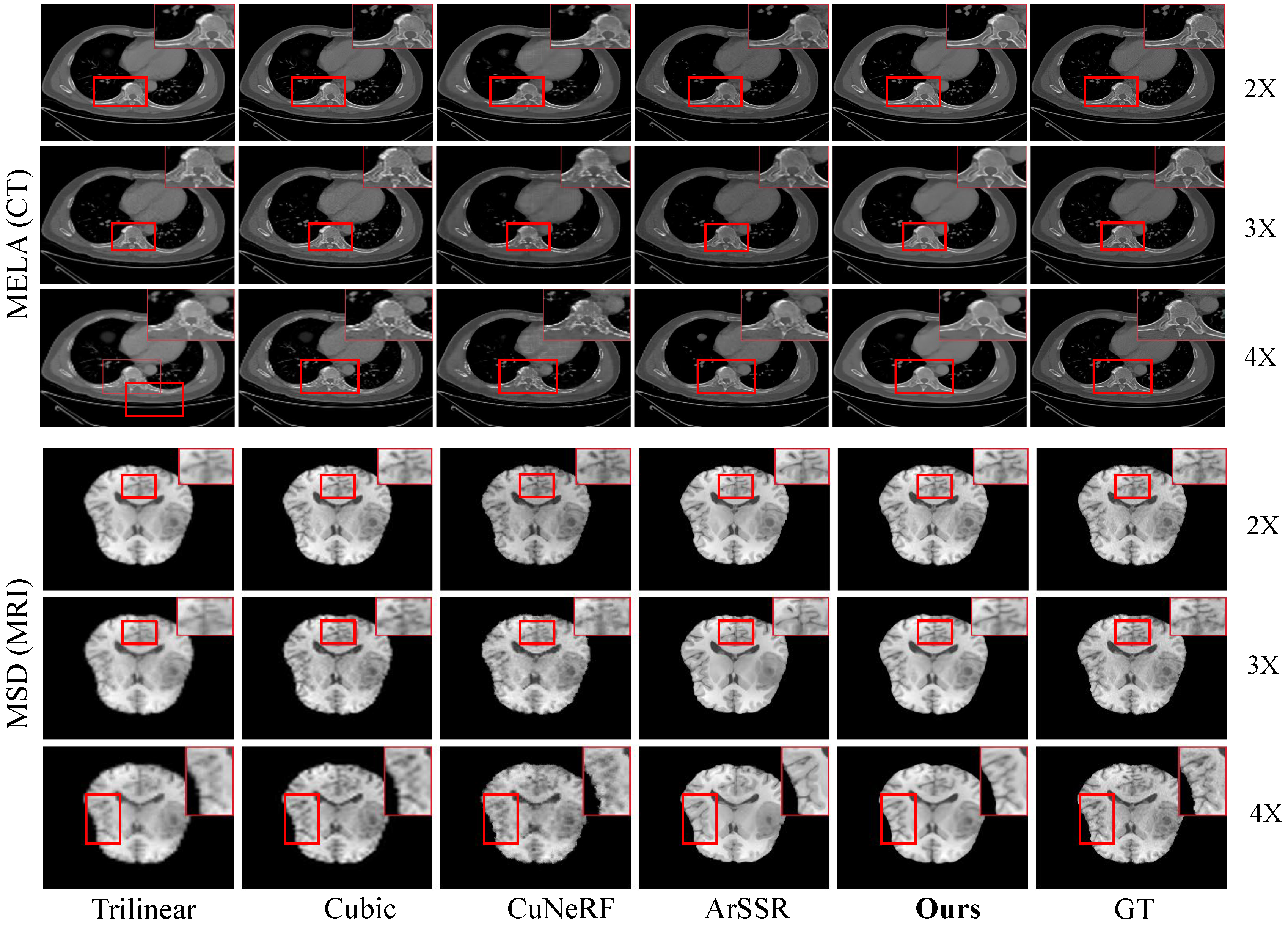
In-domain qualitative comparison on MELA CT and MSD MRI
In-domain qualitative comparison on MELA (CT) and MSD (MRI).

MSD (MRI)

Paradigm Method
PSNR ↑SSIM ↑LPIPS ↓ PSNR ↑SSIM ↑LPIPS ↓ PSNR ↑SSIM ↑LPIPS ↓
TraditionalTrilinear33.310.96700.113430.770.93770.202629.080.91000.2558
Cubic33.990.97250.098131.130.94220.208329.270.91180.2711
Self-supervisedCuNeRF32.600.97150.051330.070.95240.087828.260.93090.1271
Neural ImplicitArSSR32.870.97420.058129.560.94420.073028.510.93150.0853
FF-3DGSMedGSSR35.910.98210.033733.970.97000.070632.100.95410.1246

MELA (CT)

Paradigm Method
PSNR ↑SSIM ↑LPIPS ↓ PSNR ↑SSIM ↑LPIPS ↓ PSNR ↑SSIM ↑LPIPS ↓
TraditionalTrilinear37.510.95300.156134.830.91660.230233.840.88430.3291
Cubic37.640.96360.117935.140.92370.232534.090.88880.3263
Self-supervisedCuNeRF37.120.96540.120135.420.92350.186333.940.89570.2456
NAB-GS------34.130.9518-
Neural ImplicitArSSR38.530.96440.091436.020.94130.157634.630.92440.2261
FF-3DGSMedGSSR42.080.97380.070539.950.95580.119337.310.93620.1472

Note: For NAB-GS, due to the unavailability of its open-source code, we directly report the 4× performance quoted from their original paper.
Generalization Results: Cross-Domain 3D Super-Resolution

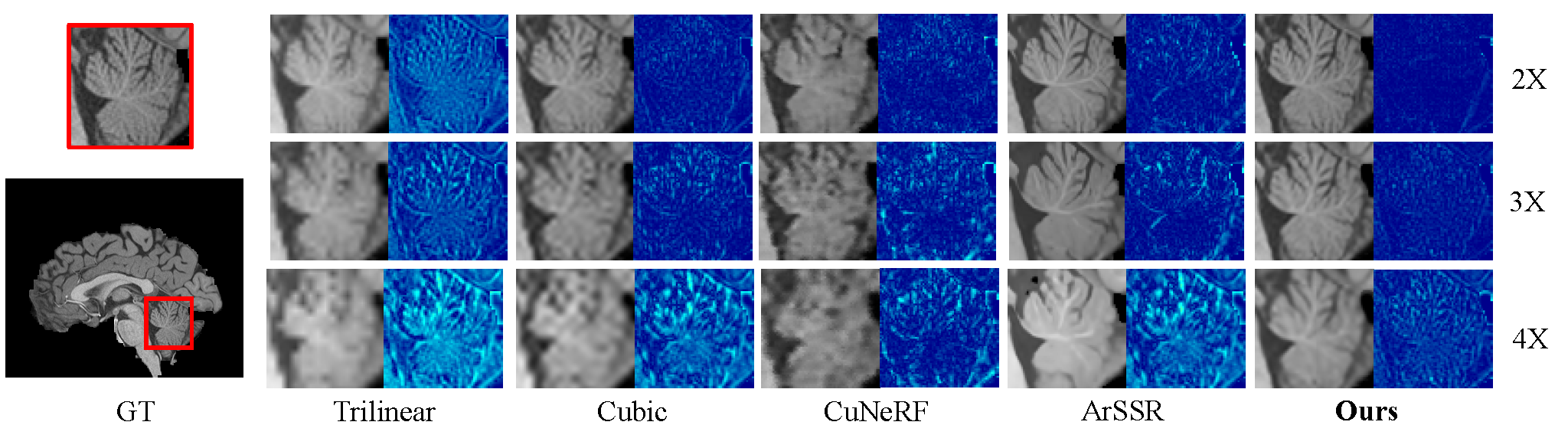
We evaluate models trained on MSD directly on the unseen HCP dataset, without fine-tuning. MedGSSR maintains strong reconstruction fidelity under MRI domain shift.

Cross-domain qualitative comparison on HCP
Cross-domain HCP (MRI) results. Models are trained on MSD and evaluated on HCP.

HCP (MRI): MSD → HCP

Paradigm Method
PSNR ↑SSIM ↑LPIPS ↓ PSNR ↑SSIM ↑LPIPS ↓ PSNR ↑SSIM ↑LPIPS ↓
TraditionalTrilinear36.450.94250.104833.750.92210.163430.760.90260.2675
Cubic36.470.95880.088534.010.92890.145431.860.91250.2483
Self-supervisedCuNeRF36.910.97160.072434.480.95470.136233.120.93820.1587
Neural ImplicitArSSR36.070.96550.061533.560.94290.089231.870.92200.1141
FF-3DGSMedGSSR40.810.98490.067437.940.97020.094535.840.95330.1253

Extended HCP 4× Cross-Domain Comparison

Method PSNR ↑ SSIM ↑ LPIPS ↓ FLOPs (G) Peak Mem. (GB) Params (M) Inference Time (ms)
MTVNet34.160.92460.13681359.501.7522.611083.18
SuperFormer33.870.91420.14461888.202.0619.661592.91
CuNeRF33.120.93820.15872061.580.120.98259.76
ArSSR31.870.92200.1141955.158.156.28105.98
MedGSSR (Ours)35.840.95330.1253385.871.2918.1356.52

Clinical Validation

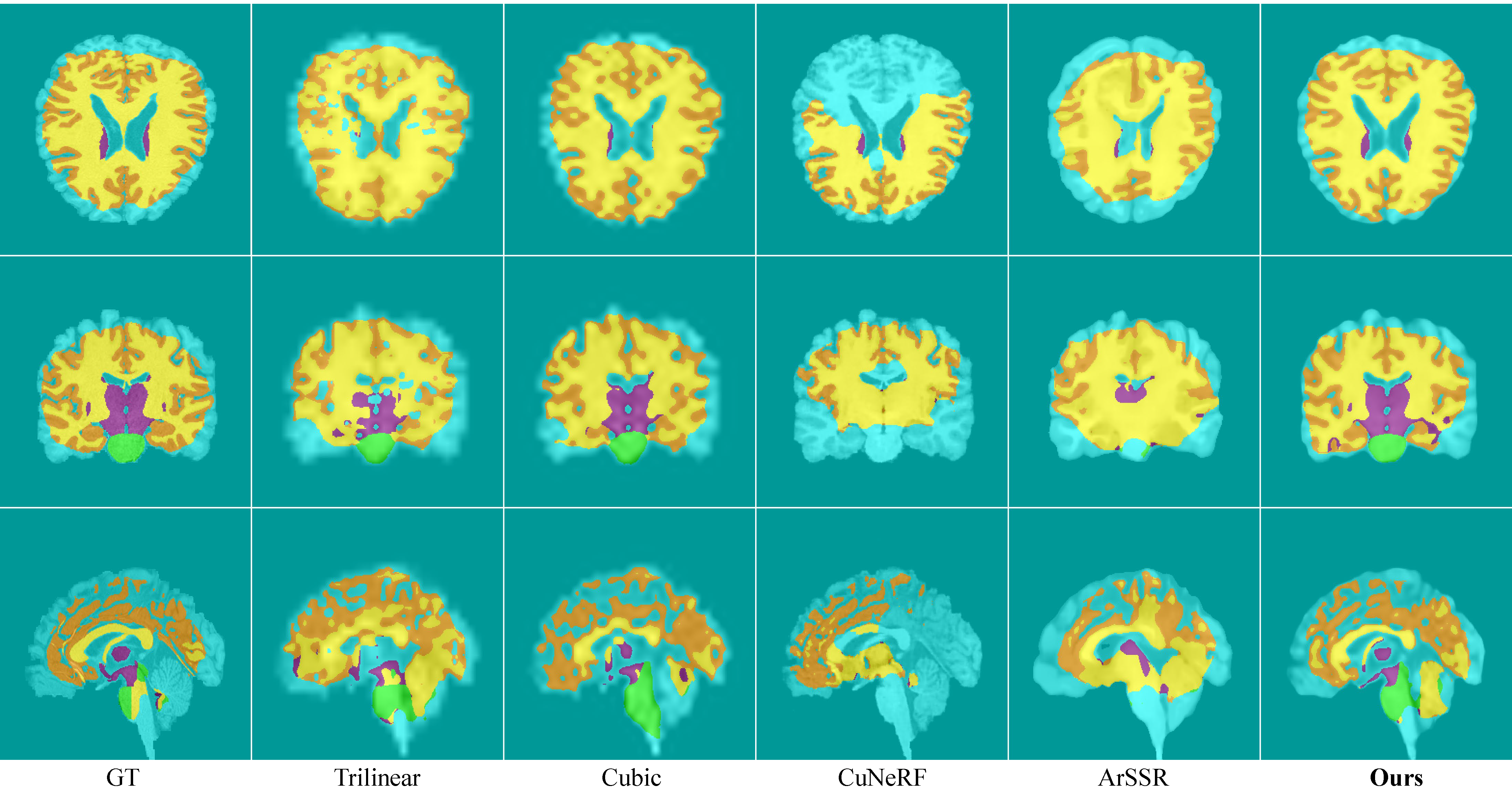
We evaluate whether higher-quality super-resolved MRI volumes improve downstream brain tissue segmentation under the challenging 8× cross-domain setting.

Clinical validation under 8x cross-domain super-resolution
Downstream brain tissue segmentation on HCP under the more challenging 8× cross-domain setting.

Ablation Study

We study the role of structure-texture decoupling, sub-voxel count, Gaussian support, frequency supervision, and reduced training data.

Sub-voxel Count

SettingPSNR ↑SSIM ↑LPIPS ↓
m = 135.980.97600.0423
m = 236.060.97710.0388
m = 4 (Default)36.600.98700.0363
m = 836.520.98620.0365

HCP Cross-Domain Ablations

VariantPSNR ↑SSIM ↑LPIPS ↓
Ours35.840.95330.1253
Ours + FFT Loss35.720.94720.1078
Ours w/ 1σ truncation31.050.91420.1608
Ours w/ 50% training data34.260.94050.1452
Ours w/ 75% training data35.490.95120.1283

BibTeX

@inproceedings{wang2026medgssr,
  title     = {MedGSSR: Generalizable Medical Image Super-Resolution 3D Reconstruction via Hierarchical Feed-forward Gaussian Splatting},
  author    = {Wang, Chengkai and Hong, Luoyu and Zhao, Yiting and Wang, Jiamin and Feng, Xiang and Qin, Feiwei and Kuang, Zhenzhong and Yin, Xuefei and Bashashati, Ali and Zhu, Yanming},
  booktitle = {European Conference on Computer Vision},
  year      = {2026}
}